
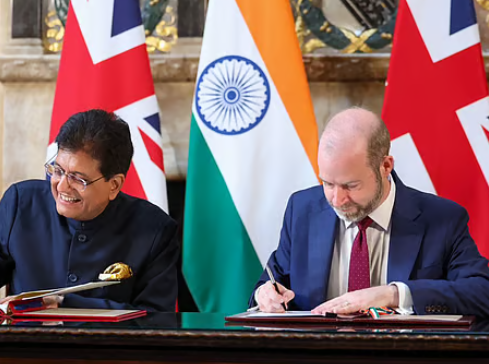
In recent years, India has significantly accelerated its engagement with Free Trade Agreements (FTAs), marking a notable shift in its trade policy approach and it can be called India’s new trade strategy using FTAs. Once cautious and often hesitant about entering comprehensive trade deals, India is now actively negotiating and concluding agreements with a diverse set of partners across regions such as the Middle East, Europe, and Oceania.
This surge in FTA activity reflects not just an economic choice, but a strategic recalibration in response to changing global trade dynamics.
A key factor driving this shift has been the rise of protectionist tendencies in major economies, particularly the imposition of higher tariffs and stricter trade measures by countries like the United States. Such developments have exposed the vulnerabilities of overdependence on a few traditional export markets.
In response, India has sought to diversify its trade relationships, secure preferential market access, and strengthen its position in global value chains through FTAs.
Additionally, the evolving global economic landscape—characterized by supply chain disruptions, geopolitical tensions, and regional trade blocs—has made it imperative for India to adopt a more proactive and outward-looking trade strategy.
FTAs are increasingly being used not only as economic tools to boost exports and attract investment, but also as instruments of strategic diplomacy. Together, these factors explain why India’s recent push for FTAs is both timely and necessary in navigating an increasingly uncertain and competitive global trade environment.
Here’s a well-structured section you can directly use under your heading:
Background: U.S. Tariffs on India
In recent years, India–U.S. trade relations have witnessed significant strain due to a series of tariff escalations imposed by the United States. Beginning in 2025, the U.S. introduced a reciprocal tariff regime, initially imposing duties of around 25–26% on Indian goods, which were later increased to as high as 50% on several exports such as textiles, gems and jewellery, and seafood. These measures were justified by the U.S. on grounds ranging from trade imbalances to geopolitical concerns, including India’s continued purchase of Russian oil.
The sharp rise in tariffs significantly affected India’s export competitiveness in one of its largest markets. Several labour-intensive sectors experienced declining exports, with some estimates suggesting notable drops in shipments to the U.S. and disruptions to industries dependent on American demand. In fact, the tariff hikes effectively eroded India’s cost advantage vis-à-vis competing countries such as Vietnam and Bangladesh, forcing exporters to reconsider their market strategies.
These developments triggered a broader phase of trade tensions between the two countries, culminating in what has been described as a major trade dispute during 2025–26, with tariffs being used as a key negotiating tool. Despite multiple rounds of negotiations, disagreements persisted over market access, non-tariff barriers, and broader strategic issues.
Although an interim agreement in early 2026 reduced tariffs to around 18%, bringing temporary relief, uncertainty continues to shape bilateral trade.
Importantly, the conclusion of a comprehensive trade agreement between India and the United States remains contingent on the finalisation of a stable and mutually acceptable tariff framework, which is still under negotiation.
Thus, the persistence of tariff-related uncertainties has not only strained India–U.S. trade ties but also pushed India to rethink its broader trade strategy, including diversifying partnerships through FTAs.
India’s FTA Boom: Expanding Trade Horizons
Against the backdrop of rising global protectionism and trade uncertainties, India has embarked on an unprecedented expansion of its Free Trade Agreement (FTA) network.
The first signs of this shift were visible in India’s agreements with the United Arab Emirates and Australia in 2022. These deals provided early momentum, offering Indian exporters preferential access to key markets in West Asia and the Indo-Pacific.
The UAE agreement, in particular, opened up opportunities for sectors such as gems and jewellery, textiles, and food products, while the Australia pact improved access for pharmaceuticals, engineering goods, and services.
Building on this foundation, India concluded a series of major agreements during 2024–25.
The Trade and Economic Partnership Agreement with the European Free Trade Association—comprising countries like Switzerland, Norway, Iceland, and Liechtenstein—marked a significant milestone, promising substantial investments and deeper integration with advanced European economies.
Similarly, the long-awaited FTA with the United Kingdom signaled a breakthrough in accessing one of the world’s largest and most sophisticated markets. Agreements with Oman further strengthened India’s presence in the Gulf region, a key hub for energy and trade.
More recently, India has expanded its FTA outreach to include partners such as New Zealand and the European Union, reflecting its ambition to integrate with major global markets. These negotiations, once concluded, are expected to significantly enhance India’s export potential and deepen its engagement with global value chains.
As a result of these sustained efforts, India today has FTAs—either operational or under negotiation—covering dozens of countries across multiple continents, ranging from Asia and Europe to Oceania and the Middle East. This expanding network is gradually transforming India into a more interconnected player in global trade.
Reasons behind India’s New Trade Strategy using FTAs
India’s recent push toward Free Trade Agreements (FTAs) is not merely opportunistic—it is a calculated response to structural shifts in the global trade environment.
Several interrelated factors explain why India is actively expanding its network of trade partnerships.
A primary driver is the need to reduce dependence on the United States, which has traditionally been one of India’s largest export destinations. Recent tariff hikes and trade uncertainties have exposed the risks of relying heavily on a single market. As demand from the U.S. becomes less predictable, India is strategically diversifying its trade relationships to ensure greater stability and resilience in its export sector.
Closely linked to this is India’s effort to access new and emerging markets across regions such as Europe, the Middle East, and Oceania. Agreements with blocs like the European Union and countries in the Gulf and Indo-Pacific regions open up vast consumer bases and high-value markets. These regions not only offer opportunities for export expansion but also enable India to integrate more deeply into regional and global supply chains.
Another key motivation is the goal of boosting exports across critical sectors. Labour-intensive industries such as textiles and leather, along with high-value sectors like engineering goods and pharmaceuticals, stand to gain significantly from reduced tariffs and improved market access.
FTAs help level the playing field for Indian exporters, allowing them to compete more effectively with countries that already enjoy preferential access to these markets.
Furthermore, India’s FTA strategy is a direct response to the broader rise of global protectionism. As countries increasingly adopt inward-looking policies and impose trade barriers, securing bilateral and regional trade agreements becomes essential to safeguard economic interests.
FTAs, in this context, act as a counterbalance—ensuring that Indian goods and services continue to find accessible markets despite a more restrictive global trade regime.
A practical example of this shift can be seen in India’s export diversification efforts amid weakening U.S. demand. Declines in exports to the American market, particularly in sectors like textiles, have prompted Indian businesses to explore alternative destinations. FTAs facilitate this transition by lowering entry barriers and providing a more predictable trade environment.
In essence, India’s aggressive FTA push reflects a broader strategic vision: to move from a position of vulnerability in global trade to one of flexibility, competitiveness, and expanded opportunity.
Challenges in India’s Expanding FTA Strategy
While India’s rapid expansion of Free Trade Agreements (FTAs) offers significant opportunities, it is not without challenges. The effectiveness of these agreements depends not only on market access but also on how well domestic industries and institutions adapt to increased global competition.
One of the primary concerns is the fear of intensified competition among domestic industries. Sectors such as agriculture, dairy, and small-scale manufacturing often worry that reduced tariffs will lead to an influx of cheaper imports, potentially threatening their survival.
For instance, producers in sensitive sectors have expressed apprehension that imports from more competitive economies—particularly in agreements involving developed regions like the European Union—could undermine local businesses that lack comparable scale or efficiency.
Another critical challenge lies in rules of origin and compliance requirements. FTAs typically include detailed provisions to ensure that only goods genuinely produced within partner countries benefit from preferential tariffs.
However, navigating these rules can be complex and costly for exporters, especially small and medium enterprises. Inadequate compliance can lead to denial of benefits, delays at borders, or even disputes, limiting the practical utility of these agreements.
Additionally, it is important to recognize that not all FTAs deliver the expected gains. India’s past experience with some agreements has shown mixed outcomes, with imports rising faster than exports in certain cases, leading to trade imbalances.
Structural issues such as lack of competitiveness, infrastructure bottlenecks, and limited awareness among exporters can prevent India from fully leveraging FTA benefits.
Overall, while FTAs are powerful tools for economic expansion, their success depends on complementary domestic reforms, capacity building, and careful negotiation to balance openness with the protection of vulnerable sectors.
Here’s a strong concluding section to tie your blog together:
Conclusion
India’s recent surge in Free Trade Agreements marks a clear transition from a historically cautious and defensive trade posture to a more proactive and strategic approach. Rather than reacting to global developments, India is now actively shaping its trade environment by forging deeper economic partnerships across regions.
In an era defined by rising protectionism, shifting supply chains, and geopolitical uncertainty, FTAs are no longer just instruments for boosting trade—they have emerged as powerful tools of economic statecraft and diplomacy.
Through these agreements, India is not only expanding market access for its goods and services but also strengthening its geopolitical presence and influence in key regions such as Europe, the Middle East, and the Indo-Pacific.
Ultimately, India’s FTA strategy reflects a broader vision of positioning itself as a major global economic player—one that is adaptable, outward-looking, and capable of navigating the complexities of an increasingly fragmented world economy.
Leave a Reply