
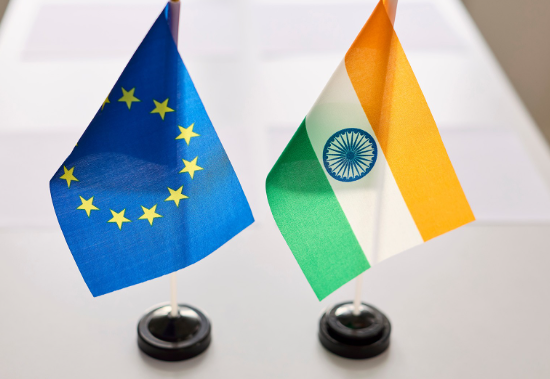
In recent years, however, there has been renewed momentum in India–EU trade deal talks, driven by shifting global economic dynamics, rising protectionism, and the need for both partners to diversify their trade relationships. For India, the FTA offers an opportunity to gain preferential access to a vast and high-value market meaning having high purchasing power, while for the European Union, it opens the door to one of the fastest-growing major economies in the world.
The EU is among India’s largest trading partners, alongside countries like the United States and China, reflecting the depth and diversity of their commercial engagement.
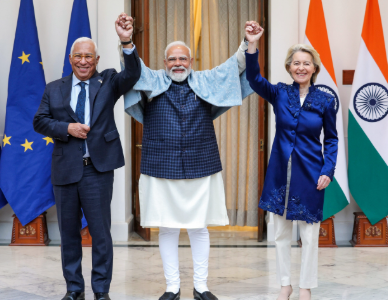
In terms of trade volume, India–EU trade deal in goods and services has grown steadily over the years, reaching well over €120 billion annually in recent estimates.
The EU accounts for a substantial share of India’s exports, particularly in sectors such as textiles, pharmaceuticals, engineering goods, and chemicals.
At the same time, India imports high-value products from the EU, including machinery, transport equipment, and advanced technology goods, highlighting a complementary trade structure.
Beyond trade in goods, the EU is also a major source of foreign direct investment (FDI) in India. European companies have a strong presence across sectors such as automobiles, renewable energy, financial services, and manufacturing. This investment relationship not only contributes to economic growth but also facilitates technology transfer, innovation, and job creation in India.
Strategically, strengthening ties with the EU also allows India to diversify its economic partnerships and reduce overdependence on traditional markets. In an increasingly uncertain global trade environment, the India–EU relationship thus serves as both an economic opportunity and a stabilizing force in India’s broader trade strategy.
History of India–EU Trade Deal Negotiations
The journey toward a comprehensive Free Trade Agreement (FTA) between India and the European Union has been long, complex, and marked by periods of both progress and stagnation.
Negotiations for what was initially termed the Broad-based Trade and Investment Agreement (BTIA) formally began in 2007, reflecting the growing importance of India–EU economic ties. The objective was to create a comprehensive framework covering trade in goods and services, investment protection, and regulatory cooperation. Early rounds of negotiations saw considerable optimism, with both sides aiming to conclude an ambitious and wide-ranging agreement.
However, by 2013, talks had effectively stalled due to deep differences on several key issues. The EU sought greater market access in sectors such as automobiles, wines, and spirits, along with stronger provisions on intellectual property rights and sustainability standards. India, on the other hand, was concerned about protecting sensitive domestic sectors and pushed for easier mobility of professionals and recognition of its data security status. These divergences, coupled with broader economic and political considerations, led to a prolonged deadlock.
After several years of inactivity, negotiations were revived in 2021, signaling renewed political will on both sides. This revival was driven by changing global dynamics, including supply chain disruptions, the rise of protectionism, and a shared interest in reducing dependence on other major economies. Since then, multiple rounds of talks have been conducted, with efforts to adopt a more flexible and pragmatic approach compared to earlier negotiations.
A significant push came in 2025, when India-EU trade deal accelerated with the aim of concluding a substantial agreement. Both sides made progress on areas such as tariff reductions, investment facilitation, and digital trade, while continuing to negotiate contentious issues like environmental standards, carbon border measures, and regulatory alignment. High-level political engagements and ministerial meetings during this period helped sustain momentum and narrow differences, although a final agreement has yet to be concluded.
Overall, the history of India–EU FTA negotiations reflects the challenges of reconciling the interests of two large and diverse economies. While progress has been uneven, the renewed momentum since 2021—and especially the intensified efforts in 2025—suggest that both sides recognize the strategic importance of reaching a mutually beneficial agreement.
Key Areas of Negotiation
- Goods (tariffs: cars, wine, textiles)
- Services (IT, mobility of professionals)
- Investment protection
- Sustainability & labour standards
Key Areas of Negotiation in the India–EU FTA The proposed Free Trade Agreement between India and the European Union covers a wide range of sectors, making it one of the most comprehensive and complex trade negotiations undertaken by India. Several key areas remain central to the discussions, reflecting both opportunities and points of contention.
1. Trade in Goods (Tariffs)
One of the most critical components of the negotiations is the reduction or elimination of tariffs on goods. The EU is seeking lower tariffs on products such as automobiles, wines, and spirits—sectors where India currently maintains relatively high duties to protect domestic industries. India, however, is cautious about opening these markets too quickly due to concerns about the impact on local manufacturers.
At the same time, India is pushing for greater access to the EU market for its exports, particularly in textiles, garments, and leather products, where tariff reductions could significantly enhance competitiveness. Thus, the negotiations in goods are essentially about balancing market access with domestic protection.
2. Trade in Services
Services form a crucial pillar of India’s economy, and the country is keen to secure better access in this domain. India is particularly focused on expanding opportunities for its IT and IT-enabled services sector, as well as ensuring easier mobility of skilled professionals (often referred to as Mode 4 under trade agreements).
The EU, however, has relatively stricter regulations regarding labour mobility, visa norms, and data protection, which makes this a sensitive and complex area of negotiation. Bridging this gap is essential for India to fully benefit from the agreement.
3. Investment Protection and Facilitation
Another major area under discussion is the framework for investment protection. The EU is interested in securing a stable and predictable investment environment with strong legal safeguards for European investors in India. This includes mechanisms for dispute resolution and protection against arbitrary policy changes.
India, on its part, has been cautious in committing to investor–state dispute settlement (ISDS) mechanisms, preferring a more balanced approach that safeguards its regulatory autonomy. Reaching a mutually acceptable investment framework remains a key challenge.
4. Sustainability and Labour Standards
In line with its broader trade policy, the EU places strong emphasis on environmental sustainability and labour standards. It seeks commitments from India on issues such as climate action, sustainable development, and adherence to international labour norms.
India has expressed concerns that such provisions could act as non-tariff barriers, potentially increasing compliance costs for its exporters. Additionally, measures like the EU’s proposed carbon border adjustment mechanisms have raised apprehensions about their impact on Indian industries.
Overall, these key areas highlight the complex balancing act at the heart of India–EU FTA negotiations—between openness and protection, growth and regulation, and economic benefits and policy sovereignty.
Benefits of the India–EU Trade deal( FTA )for India
A comprehensive Free Trade Agreement with the European Union holds significant potential for India, offering both economic and strategic advantages. As one of the world’s largest and most affluent markets, the EU presents vast opportunities that can accelerate India’s growth trajectory.
1. Enhanced Market Access
One of the most immediate benefits for India would be preferential access to the EU market, which comprises over 400 million consumers with high purchasing power. Reduction or elimination of tariffs would make Indian goods more competitive, allowing exporters to expand their presence in sectors where demand is strong. This improved access is especially valuable given the stringent standards of the EU market—gaining entry here enhances credibility and global acceptance of Indian products.
2. Boost to Exports
The India-EU trade deal (FTA) is expected to provide a substantial boost to India’s exports across key sectors. Labour-intensive industries such as textiles and garments would benefit from lower tariffs, helping India compete more effectively with countries like Bangladesh and Vietnam that already enjoy preferential access to the EU.
Similarly, pharmaceutical exports could expand with smoother regulatory pathways and greater market penetration. India’s globally competitive IT and services sector would also gain from improved access, particularly if provisions on data flows and professional mobility are eased. Overall, the agreement could significantly enhance India’s export diversification and earnings.
3. Technology Transfer and Investment Inflows
Beyond trade, the India-EU trade deal (FTA) is likely to encourage greater foreign direct investment (FDI) from European countries. The EU is already a major investor in India, and a robust agreement would further improve investor confidence by ensuring stability and predictability.
Increased investment often brings with it advanced technologies, innovation, and best practices, which can strengthen India’s manufacturing and services sectors. This is particularly important for initiatives aimed at boosting domestic production and integrating India into global value chains.
Challenges and Key Sticking Points
Despite the potential benefits, the India–EU Trade deal ( FTA) faces several significant hurdles that have historically slowed progress.
One of the primary challenges is the strict regulatory and quality standards imposed by the European Union. These include sanitary and phytosanitary (SPS) measures, technical standards, and sustainability requirements, which Indian exporters often find difficult and costly to meet. While these standards ensure high-quality products, they can act as non-tariff barriers, limiting the effective gains from tariff reductions.
India also has concerns regarding its domestic agriculture and industrial sectors. Opening up markets to European products—especially in areas like dairy, automobiles, and processed foods—could expose local producers to intense competition from highly efficient EU industries. Protecting vulnerable sectors while pursuing liberalization remains a delicate balancing act for policymakers.
Another major area of contention involves data protection and digital trade regulations. The EU’s stringent data protection regime, including requirements related to data privacy and cross-border data flows, poses challenges for India’s IT and services sector. India has been seeking recognition as a “data-secure” country to facilitate smoother operations for its companies.
Additionally, emerging measures such as the EU’s carbon border adjustment mechanism (CBAM) have raised concerns in India. These policies, aimed at addressing climate change, could impose additional costs on carbon-intensive exports like steel and cement, potentially affecting India’s competitiveness in the European market.
Strategic Significance of the India–EU Trade Deal ( FTA)
Beyond economics, the India–EU trade deal (FTA) carries substantial geopolitical and strategic importance.
Firstly, it helps India reduce dependence on traditional trade partners such as the United States and China. By strengthening ties with Europe, India can diversify its trade portfolio and mitigate risks arising from geopolitical tensions or economic slowdowns in any single region.
Secondly, the agreement would significantly strengthen India’s partnership with Europe, a region that shares interests in maintaining a rules-based global order. Closer economic ties can translate into deeper cooperation in areas such as technology, sustainability, and security.
Finally, the India-EU trade deal ( FTA )can play a crucial role in enhancing India’s integration into global value chains. By aligning with EU standards and regulations, Indian industries can improve their competitiveness and become more attractive participants in international production networks. This, in turn, can boost exports, create jobs, and support long-term economic growth.
Conclusion
The India–EU trade deal ( Free Trade Agreement) represents both a major opportunity and a complex challenge. While it promises expanded market access, increased investment, and deeper integration into the global economy, it also requires careful navigation of regulatory, economic, and political differences.
A balanced and pragmatic approach will be essential for both sides to reach a mutually beneficial outcome. For India, the key lies in leveraging the agreement to drive export growth and technological advancement, while safeguarding sensitive domestic sectors. For the EU, it involves recognizing India’s developmental priorities and ensuring flexibility in negotiations.
Ultimately, if successfully concluded, the India–EU trade deal (FTA) could emerge as a cornerstone of India’s evolving trade strategy, reflecting its shift toward a more confident, outward-looking, and strategically engaged global economic role.
Leave a Reply